September 30, 2026
Why I love the direction Valve took with the Steam Frame
Based on 3 videos




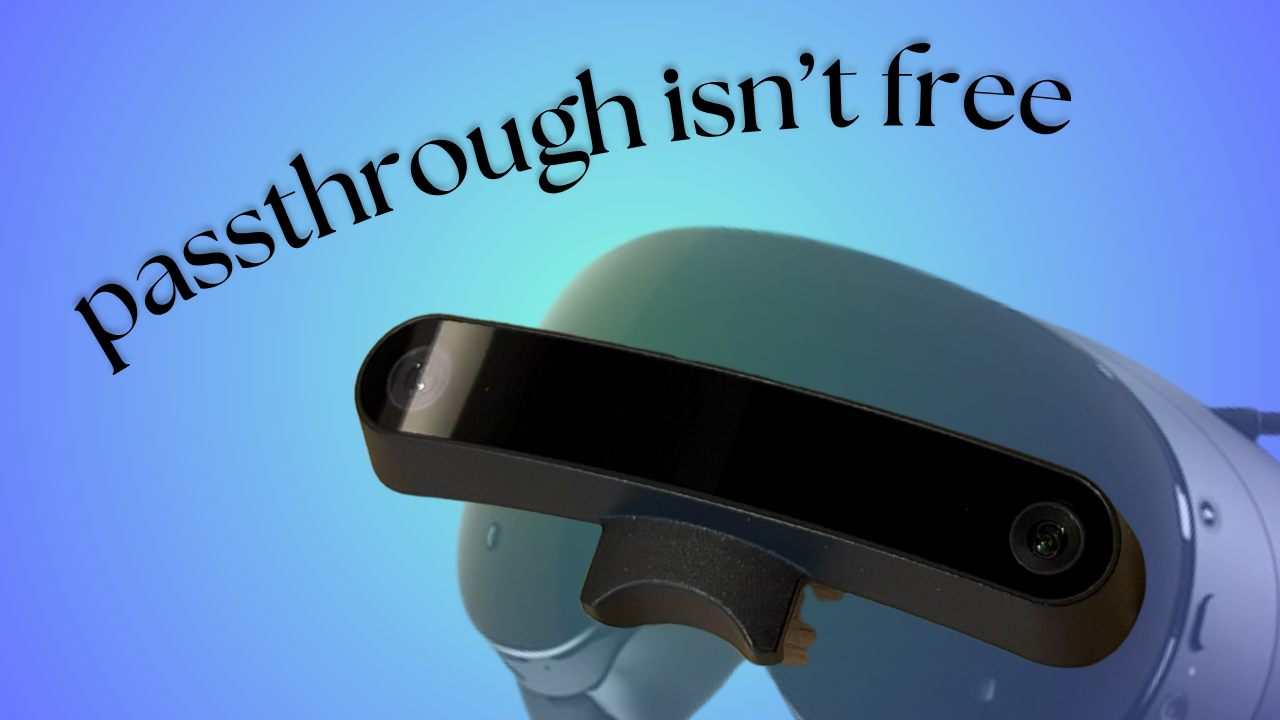
Just like most of you (I assume), I've watched many, if not all, of the Steam Frame reviews. I was lucky enough to get in the reservation queue! Many of the larger creators got waitlisted, so I feel really lucky, and I look forward to throwing my cash at Valve.
But I keep seeing over and over in the reviews some things I think are rather odd. They praise the hardware and how amazing it is, and they talk about how the software, specifically the games, are all the same, and there's nothing new or unique. The more removed a creator is from the VR space, the more this sentiment appears.
Personally, I think that's wrong, and we'll get into that later. The reviews also talk about how the standalone performance is really pathetic. Even a normally great tech reviewer like Dave2D commented on how he puts on the headset and the only thing that he can test is the same old, same old games he tested back in 2018. Namely, Beat Saber, and he talks about it as if that's the scandal of the decade or a big problem with the Frame. Personally, I don't really know what device he's looking at, because it's clearly not the Steam Frame, either that or bro needs to update his game library, because wow, there are tons of newer games than Beat Saber.
Not only that, but VR is more exciting to me now than it's ever been in the past, and it's probably because I'm fully invested in this space. I'm not just a simple tech reviewer. It's because I've been consuming content and following this niche for at least a decade, if not longer, and I'm not talking about having a museum of headsets. I am talking about VR itself. I also want to talk about how people tend to treat PCVR as if it's a game console, as if it's a platform, when it clearly is not. It has some similarities with them, thanks to Meta's failed attempts, but the entire niche is just an extension of PC gaming.
I keep seeing in these reviews that there are two different problems that keep getting mashed into a single one: what a civilian thinks VR is — so just your standard run-of-the-mill gamer, because of how Meta is treating VR — and the second problem being what the niche actually is if you are invested in the space, and these reviewers keep confusing the two.
The thing that I just cannot shut up about is the Steam Frame and the modding scene, because ultimately, that's what I believe is the true library for PC VR. That's why a wireless PC headset makes sense to me, and a standalone console in a headset a la Meta Quest does not make sense.
As I've been making my last few videos, I realized that I'm just kind of working my way through, one at a time, the biggest complaints that I keep seeing about the Steam Frame: standalone performance, the LCD panel choice, and passthrough. So this is all of it in one place. Fair warning up front: parts of this are very clearly opinion more than anything, because some of it really does come down to personal preference, and I'm not a hundred percent certain that all of you are gonna agree with my takes. That said, it's fine. Let's get into it anyway.
Yes, the standalone performance on the Steam Frame is weaker than people hoped for. But that's not an accident, it's the whole point.
Because we've known the performance targets of this device since the very first day it was announced, it is a last-gen mobile chipset, still impressively performant, but not desktop-class by any stretch of the imagination. I don't know why anyone's been expecting full desktop-class VR to be running locally in this headset. It's stronger than the Quest 3, but it's still just a last-gen phone-class processor, and it's that way on purpose. Valve chose it for a reason.
It's absolutely ridiculous to buy a wireless PC VR streaming-first headset and then get mad that the chip they put in there to support their stream decoding is not running like a 5090 for standalone VR. Honestly, I get so worked up over this topic that sometimes I have to remind myself to chill out.
Valve has been telling you exactly what the Steam Frame was going to be ever since day one of their hardware announcements. We've known all along.
They've been very clear in all their interviews as well that the Steam Frame is a wireless PC VR device first and foremost, and that standalone is just a byproduct of having enough compute on the headset to be able to support that wireless channel. And it is honestly exciting that it does support a small, limited amount of standalone play. It's honestly an incredible piece of engineering on their side.
They clearly said:
Steam Frame is a streaming-first, wireless VR headset + controllers that can handle your whole Steam library. Step into immersive VR, or lean back and enjoy your non-VR catalog. And it supports stand-alone play too.
They've been super clear all along where the focus is.
It's made even more clear when you see what comes in the box. They include the streaming dongle right there and there's no direct cable port. It supports software streaming, combining the dongle and your home Wi-Fi. There is no DisplayPort. There is no HDMI. And they have eye tracking especially for foveated streaming, and it does support foveated rendering, too. They were very clearly not trying to make a Quest. This is a wireless PC peripheral.
If you watch these reviews — or, as a lot of the reviewers did, walked in expecting a new standalone console with an awesome software event to be spoon fed to you — it's very clear you walked into the wrong product announcement and not the Steam Frame's. If you'd followed literally anything at all for the last almost year, you would have already known that going into this.
I think we might be watching the death of micro OLED panels for VR headsets.
Now, I don't actually want it to happen. I don't think micro OLED should die. I really think micro OLED is an incredibly beautiful display technology. The blacks are amazing, the color and the contrast, it has a lot of wow factor. When you first put on a Vision Pro or a Dream Air, you're absolutely blown away by the immersion because of the panels. But once you start getting used to it, and you will get used to it, you turn your head around, look at more high-contrast things, and notice that it doesn't really get as bright as you hope it would, and it starts to have serious persistence issues, and if you're really one of the unlucky ones, and there are a lot of you out there, you get excruciating headaches from it.
I've seen comments before on my posts saying the exact same things: people saying they hate how bad the smearing and ghosting is, that there's persistence issues like crazy, and then they get headaches, and that micro OLED is just awful technology and they love LCD or mini LED and can't use anything else.
Honestly, that's kind of the gist of this section for me. I want to talk about how we might be witnessing the death of OLED-based head-mounted displays. What I'm not saying is that Pimax is going to go out of business because of the Dream Air, or that Apple's going to stop making VR headsets because they chose micro OLED. I just think that the OLED panel is going to end up losing its place as the future panel of VR and AR.
This month there's been a rumor floating around, leaked news really, that Samsung is winding down manufacturing for their cheaper glass-based micro OLED panel, the one that was reportedly going into a lighter Apple Vision headset. A Vision Air, or whatever it was supposed to be called. I want to talk about what I think that actually means, and what it might mean for OLED going forward. Some people are treating it like a funeral for all of VR. Apple's made cuts in the Vision department, those things line up, and the take becomes "VR is dead." I just don't think that's true. I also want to talk about why Valve put LCD in the Steam Frame, and what two weeks owning a Vision Pro have taught me. I've had some time with it, and I have some thoughts. I'll probably sell it.
And I want to talk about what comes next for Apple, for Valve, for Meta, for the VR companies in general. Do they go deeper into micro OLED and brighter OLED panels, or do they go into something better, like mini LED, or just stick with LCD and improve the backlight?
Here's the short version of why I think Valve was right to choose LCD for the Steam Frame.
I believe micro OLED is not in the Steam Frame because it would have been the wrong call to use it. Personally, I believe LCD on a head turn is much cleaner. The Quest 3 is a very decent headset. The penalty on LCD is light bleed and the contrast not being quite as sharp, and of course a lot of people complain that blacks aren't super black. Those are real complaints, but it's not ghosting the second I start rotating my head. And you need that sharpness in VR.
If you're not familiar with micro OLED, there is this issue of persistence. If you're not familiar with what persistence is, a brief description: your eyes keep moving, and high-contrast edges trail or smear instead of cleanly moving with you.
It's not that the diodes are slow. The pixels do switch fast. The problem is the frame stays lit. Refresh rate can still be decent, a lot of these panels are 90 Hz, some 120, and you still get that smear. In the Vision Pro, I turn my head quickly and anything that's dark on the screen stays dark and kind of bleeds away to white, or vice versa. The image is hanging there too long. That doesn't mean other headsets have zero blur. It's just less of an issue. Low persistence, which you get on an LCD like the Steam Frame or the Quest 3, means the panel flashes the frame and then goes black, or gray, as a lot of people like to say, because some of the backlight is still on. When you add pancake lenses, which eat even more of the light compared to something like Fresnel, things look dimmer.
That's a benefit for the LCD: blacks look blacker while the whites are still able to really shine. But on an OLED, the whole display looks dimmer, and that bleed from the persistence is still very noticeable.
Those bright flashes on an OLED aren't as bright, because the panel can't get as bright. You also get a little more exaggerated bleed because the pancake is robbing light too. A dim micro OLED that's already darker in the first place, when it tries to strobe, tends to bleed instead.
That's still pretty much the trade-off, though I hear some things with OLED are getting better. It's still not solved completely yet. There is some interesting theory on future theoretical headset panels that could solve this completely, but it's not in reality quite yet. LCD is just simply better for motion, which is why they're cheaper too, and it's good that Valve went with them.
But what is the industry actually doing? Well. One OLED panel appears to be getting cancelled before it could even enter a mass produced headset.
The rumors are that Samsung is canceling their cheap OLED panel this month that Apple was also rumored to be using.
The thing that is being canceled or killed off by Samsung in the supply chain reporting is Samsung Display's G-VR Project partnered with Apple. It is a glass-substrate micro OLED with 1600 to 1700 PPI, roughly half that of the current-gen Vision Pro, which was meant to have been, or allegedly been, put into a lighter Apple Vision Pro headset, affectionately dubbed the Vision Air. The old rumor was mass production after 2028. This wind-down this month means that's not happening, and that's bad news. There is zero, and I mean no, explanation as to why, or if there is a replacement, or anything like that. There has only been speculation.
Tech journalist sources speculate and frame it as Apple leaving headsets for glasses. AppleInsider, reading the same report, says it's a business decision. I'm not convinced Apple actually killed the lighter, cheaper Vision or the more expensive next-gen one. I don't think there's evidence for one way or the other. There's only evidence that this panel got cancelled. Not that Apple killed a headset, and not which headset it would have gone in. People are connecting dots. If they are doing a cheaper model, I think it's more likely they just found a better display to put in it, and if they're doing a next-gen one, it has to be lighter, smaller, cheaper. That's the part I actually know, because I have used the current Vision Pro, and it will not get adopted at the current weight.
And Sony is still making expensive silicon micro OLED panels. The Dream Air is obviously shipping with them, and the Vision Pro still has them as well. So, clearly, micro OLED isn't dying right away, but losing a lower cost OLED panel is bad news for the tech.
Interestingly enough, at the Augmented World Expo, there was a demonstration for a 40,000 nit, yes, 40k nit, OLED panel. But no one talked about whether the persistence and ghosting issues with OLED were resolved.
At the Augmented World Expo in June, Samsung Display showed an OLEDoS panel, claiming 40,000 nits on a 1.3-inch panel. Oh, I looked up what OLEDoS meant, and as much as I wish it was a GLaDOS reference, it just means OLED on silicon. They called it "the Big Dipper." Clearly, there's no demo about how it performs with persistence and ghosting.
The prototype AR glasses had a smaller panel, and at least one report said that the glasses were stuck to a table. Galaxy XR is still white OLEDoS, and mass production of this new direct RGB panel, if the fab even happens, is not for another two years, and was exclusively shown off for AR purposes. Who knows if the new tech ends up in a VR headset.
I've been using my original Apple Vision Pro for about two weeks, and it's where I clearly started seeing that smear that I couldn't put a word on when I was using the Dream Air.
Both of these are great panels, but they have that persistence issue, and I didn't really know what it was until I got the Vision Pro and found it even more clearly.
I got the original M2 model used. And it came with the Solo Knit Band. Oh man, that was awful, just very uncomfortable. I had to upgrade to the Dual Knit Band because it really is infinitely better. It's still, I think, not good enough for super long work sessions. At most I could handle two, maybe three hours in it.
Obviously the Apple Vision Pro is an incredibly interesting experience. It's very awesome for passthrough, movies, and having a portable monitor. I didn't play any games on it because it's a productivity device that is too darn heavy. It's very useful to work in, but it is not a long-term working device. It's in an awkward phase. It's halfway between a toy and a genuine productivity device because of that weight.
And honestly, the display on the Apple Vision Pro is pretty beautiful, a little dimmer than I'd like, but that's just the OLED. Until I start moving my head. Ordinary head turns, high contrast especially, there's so much ghosting and so much smear. And they're both still dimmer than I want.
But back when I owned the Quest 3 and I would turn my head, I'd see none of that at all. It was really clean. LCD's problems are obviously bleed from the light and mushy contrast. OLED's problem is obviously that persistence trail and that ghosting. And of course it costs a fortune compared to LCD.
And this has honestly led me to decide that I'm going to sell the Vision Pro after I get some good usage and testing out of it. It is leaning closer and closer to a toy rather than a productivity device the more that I use it, and that is a darn shame. I want this headset to survive. I want it to be lighter, thinner, more comfortable, and have a better panel. If they did that, it would be an absolute slam dunk. "Better," from where I'm sitting, insinuates they would no longer be using micro OLED. I'm really curious about the M5 version, since I'm only talking about the original, but still, they're basically the same device. Also, they really should get rid of the uncanny valley eyeball display. Really not a fan.
Honestly, from the research I did, I feel like mini LED will be the winner. But I don't actually know for sure.
From everything that I've seen, mini LED is a really great technology, and I want honestly whatever steals LCD's motion and brightness and OLED's contrast. I have not used mini LED, and I have not used microLED. MicroLED is mostly an AR glasses projector right now, not really a VR-class panel. Mini LED is the thing that exists in VR today. It's still LCD, of a type, with a really fancy backlight. There are local dimming zones, such as in the Pimax Crystal Super, which is sitting there with about a thousand zones per eye. Reviews are pretty mixed though, which is why I don't really have much of an opinion and will be staying pretty vague. Some people say night sky is basically solved, and other people say that it's still not good enough for basic dashboards in a sim. I haven't tried it, but it's a step up from LCD and less issues than an OLED.
Most of my opinions though come from TVs. Linus of Linus Tech Tips and Linus Media Group did a version of this test with their TVs, comparing the mini LED to OLED. Their office preferred their Hisense mini LED over an OLED in a bunch of scenarios, unless you are sitting at a really awful angle. Brightness, color volume, dimming zones, they were all really good. But OLED still wins with perfect blacks and off-angle viewing. On a TV, mini LED wins. My headset eyes are not in that camp at all. TVs are one thing, but TVs are not head-mounted displays. OLED on a headset, so far from everything that I've seen with what are arguably the two best headsets on the market, loses the absolute second you start moving your head around.
I wish I had a Crystal instead of, or next to, this Dream Air, so I could compare the panels myself. I am personally very happy that Valve went with LCD because it's both cheaper and brighter. I'd love to see mini LED in something I could actually sit down and use for an extended time.
Valve has already made the decision with the Steam Frame. And it's very curious that it's looking like Apple is migrating a little bit more towards doing glasses or a lighter headset with a better panel, or their next gen Vision Pro. Maybe all of the above. I won't really treat rumors as proof though, in that case. Meta's next premium visor, the Phoenix, is still being rumored as having micro OLED with an ultralight compute puck, glasses-style nose pads, and that kind of dorky bulky glasses form factor. Personally, that looks super uncomfortable to me. I think it's ridiculous. Every smart device in that shape is bulky and painful, regardless of if the compute's on it or not. I'm still mildly interested to see what it brings, but I'm not holding my breath.
I really don't want micro OLED to die. I think it is quite beautiful tech, but it has really far to go and I don't really think they're going to solve the smear any time soon. If they're actually able to fix the ghosting, persistence, and brightness issues, and not just show a brighter still image, and it gets to go live in consumer-friendly-priced devices, I will fall in love. But until I'm able to turn my head on one of these devices and that smearing is gone, I still, and probably will always, believe that LCD is just the better headset panel. Mini LED seems like a practical next step, and I don't really know what will take the throne in the end.
I think the single most common complaint about the Steam Frame is the lack of color passthrough "like the Quest 3," with some people even saying nonsense like "it's just a Quest 3 without good passthrough," and it makes me roll my eyes every time.
I want to talk about why monochrome passthrough is such a huge deal to people. I really don't personally understand it at all. I've had Quest 3s, I had the Apple Vision Pro, and passthrough is fantastic, I love it. But when I'm playing a VR game, I literally don't care because I'm playing a game. I'm immersed. I don't need passthrough. And I know the Quest 3 has that feature where you double tap the headset and it immediately shows you the world around you, and I think I triggered that like thirty times and it was always on accident, and it just got in the way and it was annoying. Anytime I actually needed to see something around me, it was always because someone was talking to me, so I just pulled the headset off, because I'm not going to talk to them through cameras. That's ridiculous.
I also want to talk about how some folks were comparing the Frame's price to the Quest 3 price without asking why the Quest 3 is cheap in the first place in spite of having color passthrough.
And to be completely honest, I think that the dealbreaker only really exists for people who have never touched a Steam Frame, and that's so silly to me, to have your shelf broken by passthrough.
It's honestly kind of funny. If you go back long before launch, long before any of the reviews came out, there's been a ton of posts over on Reddit, especially in the Quest 3 community, where they're just full-on coping, saying things like: the Steam Frame is dead on arrival because it doesn't have color passthrough. Quest 3 is still king. And it's incredibly silly. There's even tons of people saying the only reason they're going to pass on the Steam Frame over the Quest 3 is because of the lack of color passthrough. And obviously that sentiment was everywhere. Linus Tech Tips called it a huge miss, and they hadn't even used the headset yet.
After people got their hands on the Steam Frame, such as Linus from Linus Tech Tips of Linus Media Group, or at least his scriptwriters, they walked that back immediately and admitted that they were quite surprised at how good the monochrome passthrough actually looks. Reviewers who'd normally pile on a spec sheet downgrade came closer to "this is pretty good actually" rather than "this ruins the headset," like they were claiming beforehand. But of course, if it matters to you, you could buy color passthrough.
The passthrough is being measured around 1.3 megapixels.
That's significantly sharper than Quest 2 cameras. They're just obviously not color, like the Quest 3. UploadVR was saying that it's sharper than Quest 2, but blurrier than Quest 3, and that since it's not color, you genuinely can't read a screen through it. It's not great. But we kind of already knew that it wouldn't be perfect, but neither is the Quest 3 with color passthrough. We were told that it's meant to just help you see around you, not use a monitor. Valve was very upfront with it.
But let's be honest here. I think Meta and the Quest 2 have poisoned the well. People are calibrating their expectations of the Steam Frame's passthrough to the Quest 2-era monochrome passthrough, because that is the most popular headset that had monochrome passthrough, and that's really rough, and honestly very silly. The Frame blows past that bar, blows it out of the water. The actual unfair comparison people are making is against the Quest 3's color passthrough cameras, which is a completely different and more expensive thing to build, and then acting shocked that Valve didn't just include it for free. By the actual launch, after reviews, you had people on Reddit asking why everyone had been mad about the lack of color passthrough in the first place.
People assume the Frame's missing passthrough cameras. It's not missing them. The tracking cameras just double as passthrough, which is the real reason Quest 3 needs six cameras and the Frame only needs four.
Steam Frame ships with four of those grayscale cameras plus IR illuminators in order to aid in tracking, and two of those cameras double as the monochrome passthrough. This is just a convenience feature more than anything. The Quest 3 needs two extra cameras to cover the exact same ground just in order to activate color passthrough. They have the four IR tracking cameras, just as the Steam Frame does, for SLAM, simultaneous localization and mapping, and controller tracking, plus two dedicated RGB cameras that exist purely for color passthrough. If you just strip the color passthrough cameras off of the Quest 3, the tracking hardware underneath is effectively the same architecture that Valve is using. Valve just provides you with the optional port in order to then upgrade it into passthrough or some other kind of accessory as they come. Which is honestly something I like much better. I'd rather make my own decisions on what to slot in there rather than paying upfront for the passthrough.
To be completely honest, I'll say my own Quest 3 struggled with tracking in low light really badly. I don't even know that it supported it really at all, from what I could tell. The Frame's approach is very clearly perfect in low-light, dark situations. People are saying that you can play games in the dark, and the Frame was designed around that.
But I also want to say without hesitation, the Quest 3's two extra cameras for color passthrough aren't free. They are sensors that have to be read, they have to go through processing, and they're powered by that headset constantly, whether you ever actually open the passthrough or not. The Frame's version of that cost is only opt-in. You only pay for the processing, power, and cost if you buy the camera and plug it in.
One of the funny things to me is one of the reasons people give for needing color passthrough already has a free fix. You don't even need the cameras for this.
Because the Frame ships with its own wireless adapter, a dedicated point-to-point link straight to your PC, you don't need Virtual Desktop like the Quest does. A lot of people say that they are in Virtual Desktop all the time through the color passthrough on their Quest 3. Steam will just do it natively. You don't have to worry about using a third-party application to get good streaming. That whole category of "you need color passthrough to see Virtual Desktop" argument doesn't even apply to the Steam Frame at all. If you don't need to see Virtual Desktop anymore, why do you need color passthrough? Why is that your reason for disliking the Steam Frame or calling it a deal breaker?
Another common one that I see a lot is people wanting to glance at their phone without breaking their immersion in their game. Steam Frame, however, runs a full SteamOS with Linux underneath. So tools exist that allow you to mirror your Android phone straight into it for free. That one doesn't even help me though. I have an iPhone, so my version of that workflow would be mirroring my Mac, which then mirrors my iPhone into my headset. But personally, I have no use for that. I don't use my phone in VR.
But honestly, I just don't bother with my phone at all, even with color passthrough. When I was using the Quest 3 and the Apple Vision Pro, it would honestly bother my eyes to try to look at a screen through the passthrough. I'd rather just look at a real screen with my real eyeballs than a camera's rendition of one. However, the first time I did use AR and color passthrough in general, I absolutely loved it. I don't want to downplay the amazing thing that it is, but over time, as I used it, I got annoyed that it wasn't as good, especially the Quest 3 wasn't as good as the Vision Pro's, and that's when I landed to where I actually am right now: I want my AR devices to be AR and my VR devices to be VR. I really just don't see a use case for a hybrid XR device, like most people want the Steam Frame to be. I've owned the Quest 3, and it, honestly, is just not a great experience because of the massive drawbacks of having to do and power both.
I just don't get the need for passthrough with a dedicated PCVR headset. Just take the thing off.
But I kind of get it. People have been jaded by a decade of bulky headsets and annoying straps that take forever to dial in. As an example, my Quest 3's stock strap was so bad it would take forever to get it right every single time I put the headset on. And then it wasn't necessarily completely fixed when I switched to the BoboVR headstrap, because yeah, that helped a little bit, but it still needed refitting every time I took it off and put it back on. The only headstrap VR device of any kind that worked well every time, where I put it on and took it off with little to no adjustments, was the Apple Vision Pro's dual knit band. It was honestly basically perfect. Unfortunately, that headset was a massive brick, so I just took the headset off constantly anyway because the thing was just too darn heavy.
My favorite comment that I've read: the Frame solves both problems at once. It's light enough and comfortable enough that putting it on and taking it off isn't a massive deal, which makes the resistance to just pausing a game and pulling the headset off for a few seconds downright bizarre to me. It's not like it's a wetsuit or body paint or something. You literally can just take it off and put it back on in two seconds.
But we should talk about the real cost of the Quest 3, since ultimately the arguments around passthrough boil down to "the Quest 3 has it and it's cheaper."
If you're one of those people that confuse the passthrough color argument with "buy a Quest 3 because it's cheaper," you honestly have to sit there and reckon with why it is cheaper. Back in 2021, Meta sold the Quest 2 for Business. That stripped out the Facebook account requirements, and it cost roughly double the cost of the consumer version. Had the exact same hardware, and it didn't have any ad targeting and no data harvesting. Linus Tech Tips pointed this out, and he framed that price gap as the actual price tag on what Meta was planning to collect from you. And I agree. Meta clearly just absolutely absorbs every bit of data they can, and you become the product. It is subsidized not because people are going to spend money on it, but because Meta is going to harvest money from you through it.
There's absolutely no chance that that dynamic has gone away. Meta's Reality Labs division has lost over $19 billion in 2025 against roughly $2.2 billion in sales, and in quarter two of this year alone, they lost another $4.6 billion. Quest 3's price isn't a gift. It is absolutely a loss leader, and the rest of that gap gets made up in their advertising section. It's all about your data, your attention. The absolute second their business decides that they're no longer getting the data they need to subsidize the Quest 3, they're going to outright cancel it, in spite of any backlash they might get. Color passthrough came bundled into that trade, whether or not you wanted that trade, because it enables them to harvest even more data.
Valve's direction is honestly just a better one. An optional passthrough upgrade is just a better direction.
That solution of optional features being optional is honestly fantastic. Arcturus Industries, the same team that's been building the Steam Frame's vision system, is also selling and partnering with Valve on their vision camera for $150 bucks, and you just plug it into that front expansion port, and the headset's own compositor swaps from the monochrome passthrough to color automatically. You don't need to worry about anything, it's just built in. It works right out of the box. Everyone has been saying that it's fantastic, and if you want the color passthrough, you can get it, but if you're like me and you don't, you can skip it, instead of forcing every single purchaser of the Steam Frame to eat that cost, whether they use it or not.
Granted, I've ordered one myself, because who knows, maybe it's something I end up wanting more the more I use the Steam Frame, now that I have a child. But I kind of doubt it. If it doesn't stick, I've already got a buyer lined up. My brother sits on the exact opposite side of this fence, so I'm sure it'll be worth it to him whenever he eventually gets himself a Steam Frame.
But Valve is just dead on right with their approach, I think. I love options, and this should be seen as an option! I just think that the Steam Frame is a VR headset, not an AR headset, and not some in-between XR or MR device. Building it that way first, and then letting a small number of people, or if it ends up being a large number of people who want that mixed reality or the passthrough, pay a little bit more to get that snapped right in, I think that's the right call. Some people just don't need it.
Sometimes it seemed like Meta did not fail at VR by accident. They treated the platform like a data business that happened to ship a headset.
It's pretty clear that they are well known for selling your data, and it's obvious to me, at least, that they do not have a vested interest in VR as a thing for people to play and enjoy. Their interest is hardly altruistic, nor could it be called passionate. It is motivated by extracting as much data as they absolutely can from it and maximizing their profits. There is no passion, no love for the medium.
Let's talk about the damage they've done to the space. Since 2019 they bought nine of the most prominent VR game studios, and six of those nine are now shuttered. The new games that those closed teams had shipped while under Meta's control were Quest exclusives, further damaging both consumers' perspective on the VR space as a whole, and the lives of the developers who loved VR. They were not placed in VR as a whole; they're not on Steam. They locked the software to their storefront, and that platform lock did not generate the data or income they'd hoped for. They blew billions of dollars on the wrong strategy, making trash like the metaverse, like they expected to reinvent the smartphone, or reinvent gaming as a platform, and then they were Pikachu-face shocked when their anti-consumer strategy didn't pay massive dividends.
Because they were passionate about money bags for eyes instead of an awesome gaming experience.
Which is probably why they chased XR at all. They shotgunned their strategy and hoped something would stick, and then they dumped everything else the second one of their horses won a race by pivoting to wearable AI and almost abandoning VR entirely. (Did you know they canceled the Quest 4, and then started over with it? I hope they worked fast and will have something to announce soon, but I don't expect the Quest 4 to be revealed until next year.)
The headset, Quest 3, they actually shipped is an XR device. It has passthrough, has sensors, a Snapdragon built for mixed reality instead of a normal chip that you would pick if games were the whole point of it. They stuffed AR and social experiments into their headset that should have been just a VR gaming device. And then that didn't really work out for them so they started cutting their losses. So, then what regular people start thinking is that VR is dying, when in reality it's very clear Meta's idea of what XR should be is dying.
As a PC VR headset, Quest is fine to good, despite the obnoxious hoops Meta requires you to jump through, though it doesn't work reliably enough for me as a wireless PCVR headset. When it did work, it was a nice experience. Personally, I don't think XR devices should exist. You should have an AR headset for AR experiences and a VR headset for VR experiences. Mixing them into a single XR product is how you get a device that is just really awkward or mediocre at both. The Quest 3 is an incredibly cheap device and it does pretty okay or even above average VR stuff, but is it the top-of-the-line VR headset? Absolutely not. Is it the top-of-the-line AR headset? Also absolutely not. It's lackluster, and if you've hopped into Quest games you already know they're full of children, because their approach was infantile.
A lot of these same people believe that VR as a whole, as a space, is dying. But if you spend a week in the actual community, you start realizing that what happens with Meta is not a reflection on the entire niche.
Game after game, week after week, somebody is online somewhere dropping an announcement that they have been working on a VR mod for a game that they love. Or they've already been experiencing a motion control supported mod for a game. But if you then go and open Meta's store, there's basically nothing there worth talking about. There's nothing new. There's hardly any new software. There's basically nothing official from any AAA developer anywhere. That tends to cause people to panic and think "VR is dying."
And that is because you have to be on PC VR to get anything. I think standalone VR is dying, and I'll say that out loud. Developers are leaving that world, and there's not very much modding support because of how locked down Meta's standalone VR is, you have to get hacky for SideQuest. But that is not the same thing as saying that VR is dying. Meta's VR implementation and investments are dying, and that does not reflect the overall niche at all.
Let's step back a little bit and use an example from gaming as a whole. World of Warcraft was one of the most popular, if not most popular, multiplayer games ever made.
Fast forward a little bit, after its peak, if we looked at storefront statistics specifically, that would have told you that classic World of Warcraft had effectively little demand.
Before Blizzard shipped classic World of Warcraft, there was no official way to play it, and if you only looked at the storefront and the official stats, the demand was close to nothing. Aside from a few forum posts every once in a while asking for it, relatively speaking, no one really thought about classic WoW in the broader gaming community. But then if you looked at the modding community itself, there were millions of people on private servers that were, at the time, technically illegal but extremely popular. Nostalrius alone had around 800,000 accounts and a huge active population before Blizzard shut it down. The store could not see any of that, because those players were not a product. They were already playing. A couple of years later Blizzard announced Classic, and suddenly the demand was official, and the demand is so huge that the latest BlizzCon spent significantly more time talking about classic World of Warcraft (dubbed WoW Forever) than retail WoW.
Official VR releases on Steam peaked years ago. Last year was a terrible year for new VR games. And that number does not tell you how many people are actually playing in a headset and how many mods are landing and getting played. It's the same thing as looking at Blizzard's store in 2016 and deciding nobody wanted Classic. The players were already there. They just weren't for sale. The actual VR library is happening to games that already exist.
Headset share on Steam can shrink while, from where I'm sitting, I've seen more people in this space than ever before, because we can only estimate roughly for player counts. Steam has more people than ever before with headsets, despite being a smaller fraction of the playerbase. A smaller slice of a much bigger pie is not a dead platform. Linux is a thriving ecosystem as well, and it is also a tiny slice of Steam. Nobody has a clean number for hours played in VR except Valve, and the people dooming on storefront charts are pretending that they do, and that they know that VR as a whole is dying when it is not, and Valve still building VR headsets is proof it is worth supporting.
So that said, when I get my Steam Frame, what am I actually going to be playing? What is new to play since last year?
Dave2D put the review take pretty directly:
It's been years since any major publisher has put out a PC VR game. And I think that is a major problem because on hardware release like this… this, in my opinion, should be accompanied with the launch of an equally amazing software title.
Well, for one thing, I do need to finish my Half-Life 2 playthrough in VR, although that is not actually new. What is new, though, is Ready or Not is in VR, and Cyberpunk 2077 is in VR. No Man's Sky had some decent updates that I want to try out. And I have somehow never actually played No Man's Sky in VR for more than a few minutes, and it's still getting updates, and people who are in this niche will tell you it is a great VR experience. And it's not just those. There's game after game. I saw a video just this week about Titanfall 2 getting VR with six degrees of freedom motion controls. I want to try that. That sounds awesome. I loved Titanfall 2. These are all new games from this VR perspective. I love VR, I love jumping into a familiar world with a new experience!
Now, clearly, that list is not comprehensive, this is just what I am excited about. I find more and more motion control conversions to VR every single week. You don't need a triple-A studio to make this platform worth putting on your face. You need a PC and a community that's already doing the work, and they have been.
And on top of that, people think that you need an absolute monster of a PC to play VR at all.
You clearly don't. The reputation is running way far ahead of the actual hardware. If you already have a gaming PC, and most have a 3060 as per Steam charts, you can run VR. Heck, I think the Steam Machine itself is an excellent example of that. It is a mid-tier gaming device with, a lot of people claim, six-year-plus-old hardware in it, and it's still very capable with VR, even the modded VR scene.
None of these games require a $7.5k RTX 5090 to play, enjoy, or run well. For pete's sake, they got Half-Life: Alyx playable on a phone chip for the launch of the Steam Frame. Clearly you don't need mind bending power to run VR.
VR is clearly not dead nor dying.
Don't take insight into the VR niche from people who are clearly not in the space. They jumped in and did a quick review on the Steam Frame, then put a review through a garbage disposal and called it good enough before moving on to talk about the latest iPhone launch. The Steam Frame is a wireless PC VR headset, and tech reviewers and YouTubers reviewing it online are clearly upset that they weren't spoon-fed unique launch titles, because they didn't have the time to actually dive in.
So many people expected a brand new gaming console, but then what they got was a peripheral, and they scratch their head and go, "Oh my gosh, VR is dead."
What do you think? Do you think that the Steam Frame needed a unique launch title to matter? Or is it also clear to you that wireless PC VR was the entire goal all along, and it's allowed to just play the library you already have from the PC you already game on? Do you still stand by the idea that the lack of color passthrough is a dealbreaker, or are you more moderate and think it's just a minor downside? Are you with me that the lower cost is just smarter, and that optional add-ons were the right way to go? And do you think OLED is still the future of head-mounted displays, or has LCD or mini LED already won?
Thanks for reading. I'll catch you in the next one.